

Enterprise AI,
Secured & Managed
Connect your systems. Automate your workflows. Keep your team in control.

Sound Familiar?
The AI opportunity is real. But so are the blockers.
Your Team Is Drowning in Manual Work
Decisions made case-by-case. Reports pulled and emailed by hand. Thousands of applications screened manually. Your people are busy, but not productive.
Your Data Can't Leave, but Neither Can the Status Quo
Regulators demand audit trails. Leadership demands privacy. But spreadsheets and email aren't compliant either. You need AI that runs inside your fence.
Your Systems Don't Talk to Each Other
ERP here, spreadsheets there, a legacy tool in between. Nobody has the full picture. An AI agent is only as good as the data it can reach.
What You Can Build
Real use cases. Real outcomes. Humans lead, AI augments.
Convene an AI Advisory Board
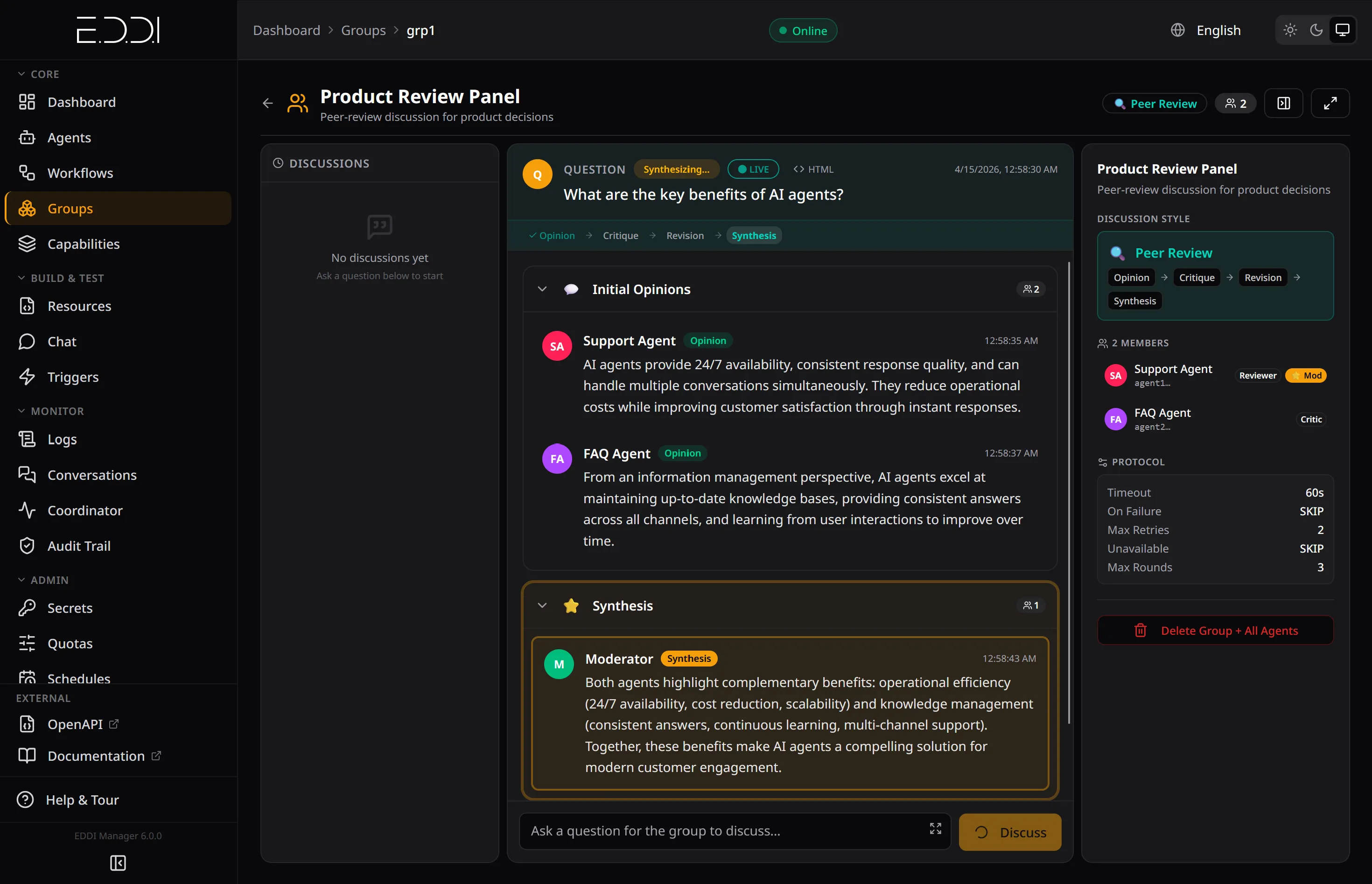
Put a panel of specialized AI agents around the table, each with its own expertise, data, and point of view, and let them deliberate your hardest calls. Choose how they reason: an open round table, a structured debate, an anonymous Delphi round, a devil’s advocate stress-test, or a negotiation that trades toward an agreement. When it matters, put the question to a formal vote. You get every viewpoint, the dissent, and a synthesized recommendation. A human always signs off.
The questionShould we sign a 3-year contract with a new logistics supplier?
- LegalReads the contract terms
- FinanceChecks price and volume
- RiskLooks for what can go wrong
Choose how the board reasons
What is differentEveryone answers independently and at the same time. A moderator then merges the answers into one recommendation.
The draft renews automatically for another 3 years unless we give 12 months notice, and it has no exit right for repeated late deliveries. I would not sign it as written.
The rates are 8% below our current carrier, but only if we meet a volume floor. At last year’s volume we stay above it, with a thin margin.
This supplier would carry most of our freight. One failure at their main hub could stop our shipments for days.
Sign only with changes: an exit right after repeated late deliveries, a lower volume floor, and a backup carrier for at least 20% of volume.
Sign, but only with three changes
Recorded dissent: Finance would accept a backup carrier for 15% of volume instead of 20%.
Approval needed: Group phase Synthesis
- Question
- Should we sign a 3-year contract with a new logistics supplier?
- Recommendation
- Sign, but only with three changes
Only approvers on the allow-list can decide. Every decision is written to the audit ledger.
What is differentTwo sides argue for and against, then answer each other. An impartial judge scores the arguments and names a winner.
Sign. The rates are 8% below our current carrier and the capacity guarantee covers our busiest season. Three years locks in that price.
Do not sign as written. Three years with one supplier, no exit right and no backup carrier is a risk we cannot undo.
The saving is certain, and a backup carrier can be added later.
Later is the problem. Once we sign, we lose the leverage to ask for an exit clause.
Con is better supported. The saving is real, but the contract makes it hard to reverse. Renegotiate the exit and backup terms first.
Renegotiate before signing
Verdict: Con wins. Score: Pro 4/10, Con 9/10, judged on argument quality and evidence, not on how forcefully it was put.
Approval needed: Group phase Judge verdict
- Question
- Should we sign a 3-year contract with a new logistics supplier?
- Recommendation
- Renegotiate before signing
Only approvers on the allow-list can decide. Every decision is written to the audit ledger.
What is differentExperts estimate in isolation, see only an anonymous summary, and revise. Rounds repeat until the estimates converge.
Late deliveries per 100 shipments in year one. A: 12. B: 4. C: 7. Nobody sees who said what.
After seeing only the anonymous summary (range 4 to 12, median 7), they revise. A: 9. B: 6. C: 7.
The spread narrowed from 8 points to 3. The panel has converged, so no third round is needed.
Plan for about 7 late deliveries per 100 shipments in year one. The contract needs delay penalties from 5 per 100 and a review after 12 months.
Sign with delay penalties and a 12-month review
Convergence: Two rounds. The spread narrowed from 8 points to 3. Individual estimates stay anonymous between agents.
Approval needed: Group phase Synthesis
- Question
- Should we sign a 3-year contract with a new logistics supplier?
- Recommendation
- Sign with delay penalties and a 12-month review
Only approvers on the allow-list can decide. Every decision is written to the audit ledger.
What is differentOne agent is assigned to attack the emerging consensus. The others must defend their position or change it.
I recommend signing. The rates are lower and the supplier guarantees capacity.
Assume this fails in year two: the supplier loses its main warehouse and we have no backup. What happens to our shipments?
The guarantee does not cover a lost warehouse. You are right. We need a backup carrier for part of the volume.
I can add a right to terminate if delivery targets are missed. That answers the exit problem.
The challenge changed the outcome from “sign” to “sign with conditions”: a termination right and a backup carrier.
Sign with a termination right and a backup carrier
Recorded dissent: Risk still prefers a 12-month pilot over a 3-year term.
Approval needed: Group phase Synthesis
- Question
- Should we sign a 3-year contract with a new logistics supplier?
- Recommendation
- Sign with a termination right and a backup carrier
Only approvers on the allow-list can decide. Every decision is written to the audit ledger.
What is differentOne agent drafts, the others critique, and the author revises. The recommendation is the revised version, not the first draft.
Sign for 3 years. It saves 8% against the current carrier.
The saving depends on a volume floor you did not mention. If we ship less, we pay for volume we do not use.
There is no backup carrier in the draft.
Revised: sign for 3 years only with a lower volume floor and a backup carrier for 20% of volume. The saving falls to about 5%.
Both critiques are addressed in the revision. One item stays open: Legal still needs to negotiate the exit clause.
Sign the revised terms once the exit clause is agreed
Recorded dissent: Legal: the exit clause is not yet negotiated.
Approval needed: Group phase Synthesis
- Question
- Should we sign a 3-year contract with a new logistics supplier?
- Recommendation
- Sign the revised terms once the exit clause is agreed
Only approvers on the allow-list can decide. Every decision is written to the audit ledger.
What is differentThe question is split into tasks. Agents work on them, and a different agent verifies each result before it counts.
Task 1: Legal reviews renewal and exit terms. Task 2: Finance calculates the break-even volume. Risk then verifies both.
Done. Automatic renewal and no exit right found. A proposed replacement clause is attached.
Done. The new rates beat the current carrier as long as we ship at least 85% of last year’s volume.
Task 2 checked against last year’s shipment data: correct. Task 1: the proposed clause closes the gap.
Both tasks are verified. Sign with the replacement exit clause and a volume floor at or below 85%.
Sign with the new exit clause and a volume floor of 85% or less
Task status: 2 tasks planned, 2 completed, 2 verified by another agent.
Approval needed: Group phase Synthesis
- Question
- Should we sign a 3-year contract with a new logistics supplier?
- Recommendation
- Sign with the new exit clause and a volume floor of 85% or less
Only approvers on the allow-list can decide. Every decision is written to the audit ledger.
What is differentAgents with competing interests trade concessions until they reach an agreement, instead of one side winning.
I want the 3-year term. It secures the 8% discount.
I want 12 months with an option to renew. No lock-in before the supplier proves reliable.
A 3-year term with a right to terminate after 12 months if on-time delivery falls below target.
I accept the termination right and a backup carrier, if the discount applies from day one.
I accept the 3-year term, if the backup carrier covers at least 20% of volume.
Agreement: 3-year term, termination right after 12 months for missed delivery targets, backup carrier for 20% of volume, discount from day one.
Sign the 3-year term with the agreed trade-offs
Concessions recorded: Finance accepted a termination right. Risk accepted the 3-year term. Both concessions are on record.
Approval needed: Group phase Synthesis
- Question
- Should we sign a 3-year contract with a new logistics supplier?
- Recommendation
- Sign the 3-year term with the agreed trade-offs
Only approvers on the allow-list can decide. Every decision is written to the audit ledger.
A mock conversation to show how each style works. Real boards use your own agents, data and rules.
Smarter Decisions, Faster
Multiple AI perspectives evaluate each case against your explicit criteria, then a human decides. Every recommendation logged with rationale.
Reports That Think, Not Just Summarize
Scheduled agents pull from your ERP, CRM, and spreadsheets, flag what matters against your forecast, and push role-based insights to the right people, automatically.
Days to Hours in Regulated Workflows
Document ingestion, automated eligibility checks, and exception flagging for lending, onboarding, or procurement. A human approves every decision. Full audit trail.
Screening at Scale Without New Headcount
AI-assisted screening of applications, candidates, or leads, scored against your standards. Your team reviews the shortlist, not every application.
How It Works
Three steps. You stay in control.
The same EDDI, three ways to run it. Pick where the trust boundary sits.
On-premises / air-gapped · Your data centre
On-premises or air-gapped deployment. Everything runs inside your data centre: your data sources, an identity provider (Keycloak or your OIDC IdP), the EDDI engine with its built-in secrets vault and its HMAC-signed, append-only audit ledger, local models (Ollama or Jlama), and the Manager approvals page. There is no outbound path to LLM providers. You operate it.
- Operated by
- You
- Data lives in
- Your data centre
- Leaves the boundary
- Nothing to LLM providers; models run locally
Your cloud · AWS, Azure, GCP, OpenShift
Deployment in your own cloud: AWS, Azure, GCP or OpenShift. Inside your VPC or cluster run your data sources, an identity provider (Keycloak or your OIDC IdP), the EDDI engine with its built-in secrets vault and its HMAC-signed, append-only audit ledger, an optional model hosted in your VPC, and the Manager approvals page. Outside the boundary are only the LLM provider you configure and, optionally, Slack for approvals. You or LABS.AI operate it.
- Operated by
- You or LABS.AI
- Data lives in
- Your cloud account, in the region you choose
- Leaves the boundary
- Only to the LLM providers and channels you configure
Managed by LABS.AI · Dedicated instance in EU, Swiss, US or Singapore
Managed by LABS.AI on a dedicated instance in the EU, Switzerland, the US or Singapore. Inside the boundary run the EDDI engine with its built-in secrets vault and its HMAC-signed, append-only audit ledger, and the Manager approvals page. Outside the boundary stay your data sources, reached through connectors configured for you, your OIDC identity provider, which hands tokens to EDDI, the LLM provider you configure, and optionally Slack for approvals. LABS.AI operates it, including upgrades and security patching.
- Operated by
- LABS.AI
- Data lives in
- Your dedicated instance in the EU, Switzerland, the US or Singapore
- Leaves the boundary
- Only to your own systems, and to the LLM providers and channels you configure
- Decisions made case-by-case
- No record of why a call was made
- Data scattered across third-party tools
- Consistent decisions against your criteria
- Every step logged and explainable
- Data stays inside your own perimeter
Nothing Ships Without a Human
Oversight is a feature of the platform, not a promise in a slide deck. You decide what needs sign-off, and EDDI enforces it.
Approvals, rejections, and timeouts land in the same immutable audit ledger as the decision itself.
Why gates, and why few: in a controlled study, three binding human decision gates cut critical failures in AI-assisted work from 72% to 16%. Past a point, though, more review makes people approve on autopilot. So you set approval friction per action, and the routine ones stay frictionless. See the research ↗
Everyone Gets Their Own Access, Not a Shared Login
EDDI knows who is asking. Agents and their credentials belong to people and teams, and an agent can be held to exactly what the person using it is allowed to do.
Agents That Read the Documents Your Business Runs On
Contracts, invoices, scans, recordings. Your people attach images, PDFs, audio, and video to a conversation by upload, by link, or straight from your systems, and the agent works with what it is given. Knowledge bases keep your manuals, policies and website current for every agent: EDDI crawls your site and ingests your PDF, Word, Excel and PowerPoint files on a schedule.
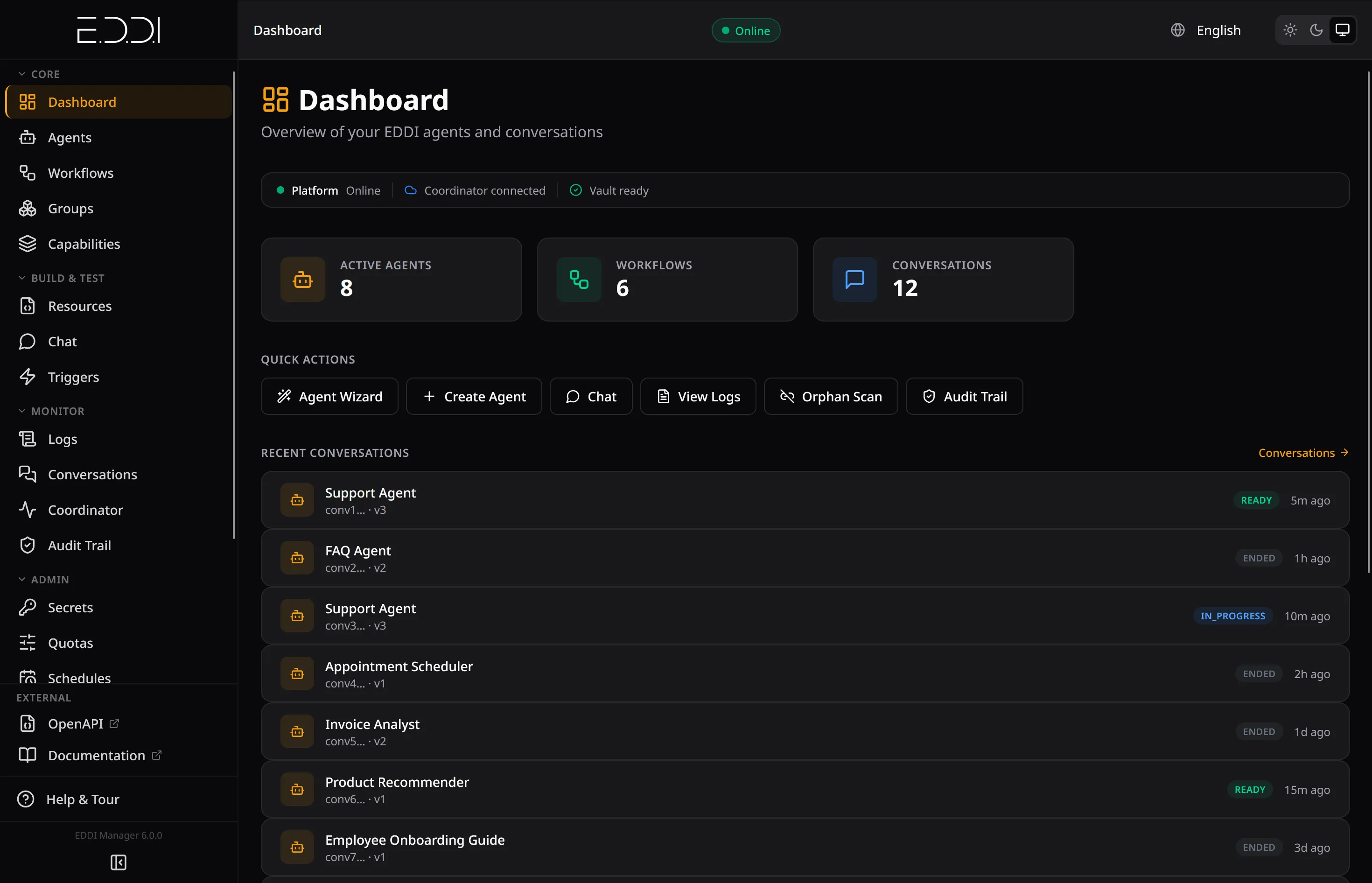
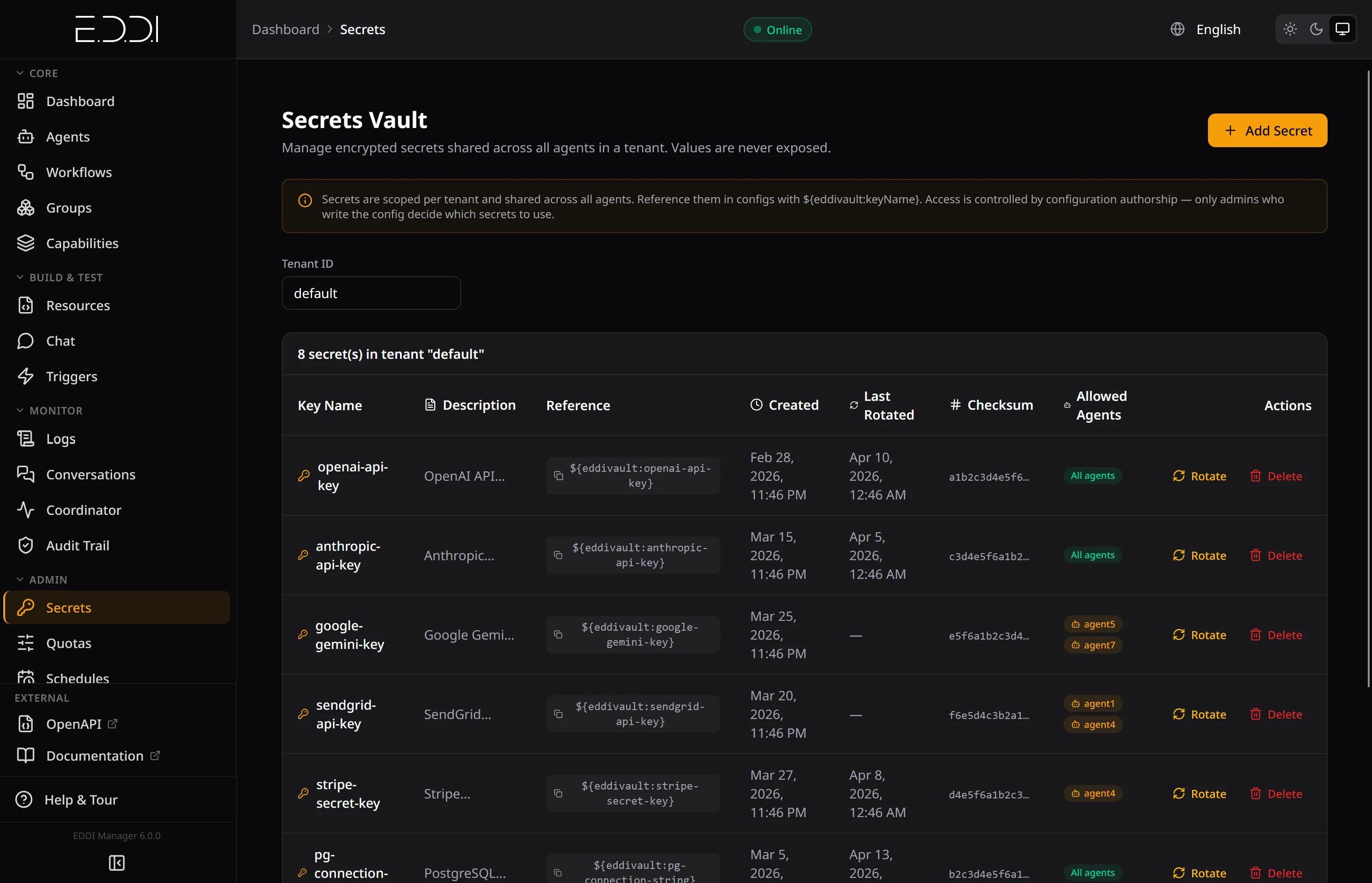
See the Product
The EDDI Manager is where your team builds agents, runs advisory boards and keeps the keys. These are real screens, not mock-ups.
Why EDDI
Production-grade AI orchestration. Open source at the core. Enterprise support around it.
Battle-Tested, Not Experimental
In continuous development since 2006, open source since 2018. 20,000+ tests. The OpenSSF Best Practices Gold badge. This is production-grade infrastructure, not a startup MVP.
Guaranteed Uptime & Response
Enterprise SLA with committed uptime, response times, and resolution. Your AI agents are mission-critical, and we treat them that way.
You Build Value, We Run the Platform
Deployment, scaling, monitoring, and updates are handled. Your team focuses on the business problem, not the infrastructure.
Every Decision Logged & Tamper-Evident
Immutable audit trails with cryptographic integrity. 15+ regulatory frameworks. Compliance by architecture, not afterthought.
Works With Any LLM You Run
Already running a local model? We orchestrate around it. EDDI connects to 19 LLM providers, from Claude, GPT and Gemini to DeepSeek, Qwen and Mistral, or a model on your own hardware. Open source, Apache 2.0, no vendor lock-in.
Your Data Stays Inside Your Fence
Self-host or sovereign cloud. No data sent to third-party APIs without your say. Vault integration, OIDC, and full URL validation built in.
Open source or managed?
The platform is the same. The difference is who runs it and what surrounds it.
Self-hosted open source
You run it
- Free, Apache 2.0 licence
- You install, operate and update it yourself
- Community support on GitHub
- Full platform, with audit ledger and approvals built in
EDDI Solutions
We run it, or run it with you
- We run it for you, or alongside your team inside your perimeter
- SLA up to 24/7 with 1h response (Enterprise)
- Upgrades and security patching handled by us
- Custom connectors and MCP tools built for you, for example to SAP or internal APIs via OpenAPI
- Dedicated instance in the US, EU, Switzerland or Singapore, or sovereign, on-prem and air-gapped
- Compliance packs and audit-evidence support
Proven in Production
UNIDO Trusted Partner for Industrial AI for the Global South
LABS.AI has been selected by the United Nations Industrial Development Organization (UNIDO) as a Trusted Partner for Industrial AI for the Global South: independent validation of EDDI’s enterprise readiness.
Learn more about the partnership →Trusted & Certified


Ready to See It in Action?
Tell us your use case. We’ll show you how EDDI handles it, with a personalized demo on your data.
Frequently Asked Questions
Where does my data go?
Nowhere you don’t control. EDDI can run fully self-hosted on your infrastructure, in a sovereign cloud instance, or in our managed EU cloud. Your data never touches a third-party API unless you explicitly configure it. Every deployment includes an immutable audit ledger.
Does this replace my team?
No. Humans lead, AI augments. EDDI agents recommend, flag, and analyze, but a human always makes the final decision. We design every workflow with a human-in-the-loop checkpoint. Your team does less busywork and more judgment work.
We already run a local LLM. Does EDDI compete with that?
The opposite. EDDI is LLM-agnostic, it orchestrates around your existing model. Swap providers, cascade between models to cut cost (published deployments of the pattern report 31 to 58% lower inference cost at held quality), or run fully local. EDDI is the orchestration layer, not the LLM.
How long does a proof of concept take?
Typically 2-4 weeks for a focused POC. The biggest variable isn’t the technology, it’s making your decision criteria explicit and wiring the data sources. We’re honest: ~70% of the work is alignment and data, not code.
Our data lives in SAP, Excel, and three legacy tools. Can EDDI connect to all of that?
Yes. Agents reach your APIs and business systems through HTTP calls, MCP servers, and OpenAPI specs, and Connections handle the credentials, from an organization-wide key to each user’s own OAuth account. The first step of every engagement is mapping your data landscape and building the connectors. Messy data is the norm, not the exception, we plan for it.
Can our people send agents actual documents, not just text?
Yes. Images, PDFs, audio, and video can be attached to a conversation by upload or by link, and knowledge bases can crawl your website or ingest your files on a schedule so every agent answers from current documents. PDFs are extracted to text automatically so any model can use them, and images are routed to a vision-capable model. Attachments are access-controlled with per-tenant quotas, and they are deleted together with the conversation, so a GDPR erasure request covers them too.